
ELK GROVE VILLAGE HOMEOWNERS
Your Crawlspace Is Failing—
And It’s Affecting Everything Above It
The original Centex crawlspace construction from the 1950s and ’60s wasn’t built for Chicagoland’s climate or clay ground. Here’s what that means for your home — and what to do about it.
Serving Elk Grove Village & the
Northwest Suburbs
True Seamless Encapsulation
100-Year Life Expectancy
Elk Grove Village Was Built to Last. Your Crawlspace Wasn’t.
When Centex Corporation developed Elk Grove Village in the mid-1950s, they built something that became a model for suburban America. Thousands of homes went up fast, and the community grew from a population of 116 at incorporation in 1956 to over 33,000 residents today. The schools came, the parks came, the business park came — now one of the largest industrial parks in North America, with nearly 100,000 people working within its borders. But some things from that era didn’t age as well.
The original crawlspace construction used in many Elk Grove Village homes — terracotta sump pit and draintile dewatering systems, surface water flow, plastic sheet over clay — was designed for the weather of Texas. Heavier rains, settling soil, cracked foundations and decades of Illinois freeze-thaw cycles have pushed those old systems past their limits. And the rockwool insulation that was standard in many of those original Centex builds? It’s now a known health concern, releasing airborne fibers that affect your lung health every time air moves through the crawlspace below your feet.
Your home has held up. It’s time to update what’s underneath it.
If You’re Seeing Any of These Signs, Your
Crawlspace Is Already in Trouble
If two or more of those apply, your crawlspace is actively working against your home’s comfort, air quality, and energy efficiency. And it’s not going to fix itself.
Musty Smells
In your basement or first-floor rooms.
Cold Floors
In winter, even with the heat running.
High Energy Bills
Higher-than-expected heating and cooling costs.
Humidity & Condensation
Issues inside the home
Foundation Cracks
Visible cracks on the foundation walls.
Standing Water
Or soft, spongy ground in the crawlspace after rain
Original Rockwool Insulation?
If you have the old black tar-sprayed over fiber kind, it needs addressing immediately.
There’s a Reason Standard Vapor Barriers Keep Failing Here
Most contractors will quote you plastic sheeting and tape. It’s cheap, it goes in fast, and it looks fine in photos. But a few years down the road in an Illinois climate, the tape peels, the plastic shifts, and moisture finds every gap. Anyone who comes in to service your HVAC or plumbing punches right through it.
Concrete sounds more permanent, but it’s porous, it cracks and the curing process releases significant moisture for weeks — exactly the opposite of what you’re trying to achieve.
Neither of those approaches was designed for the specific conditions under an Elk Grove Village home. Ours was.
The True Seamless Nu-Crawl Encapsulation Method—Built for Homes Like Yours
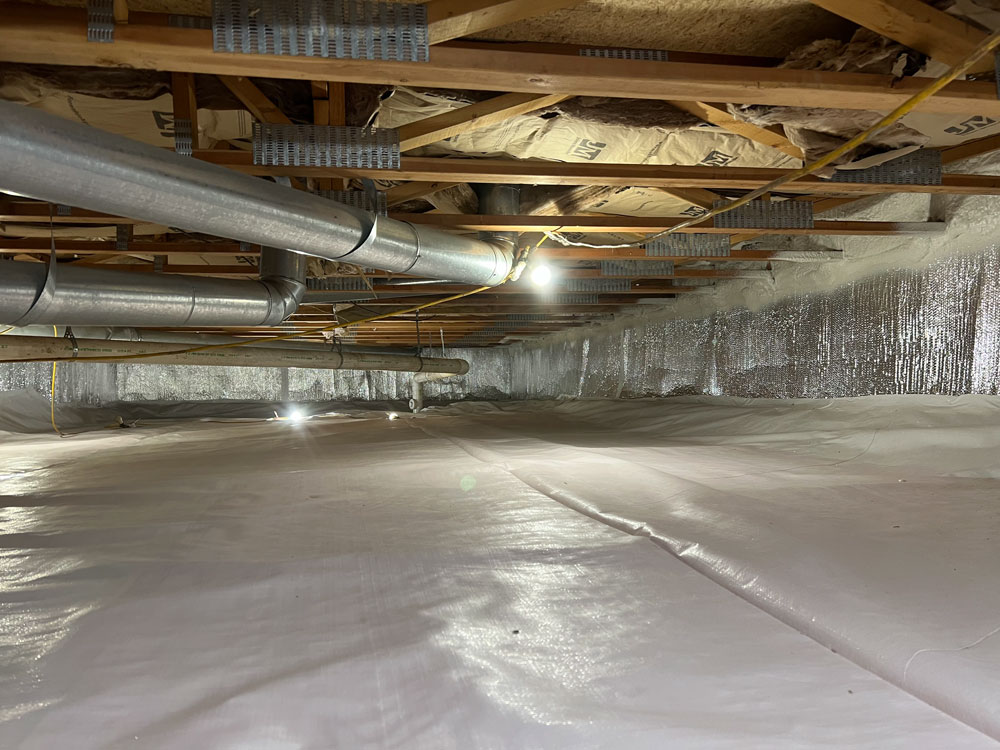
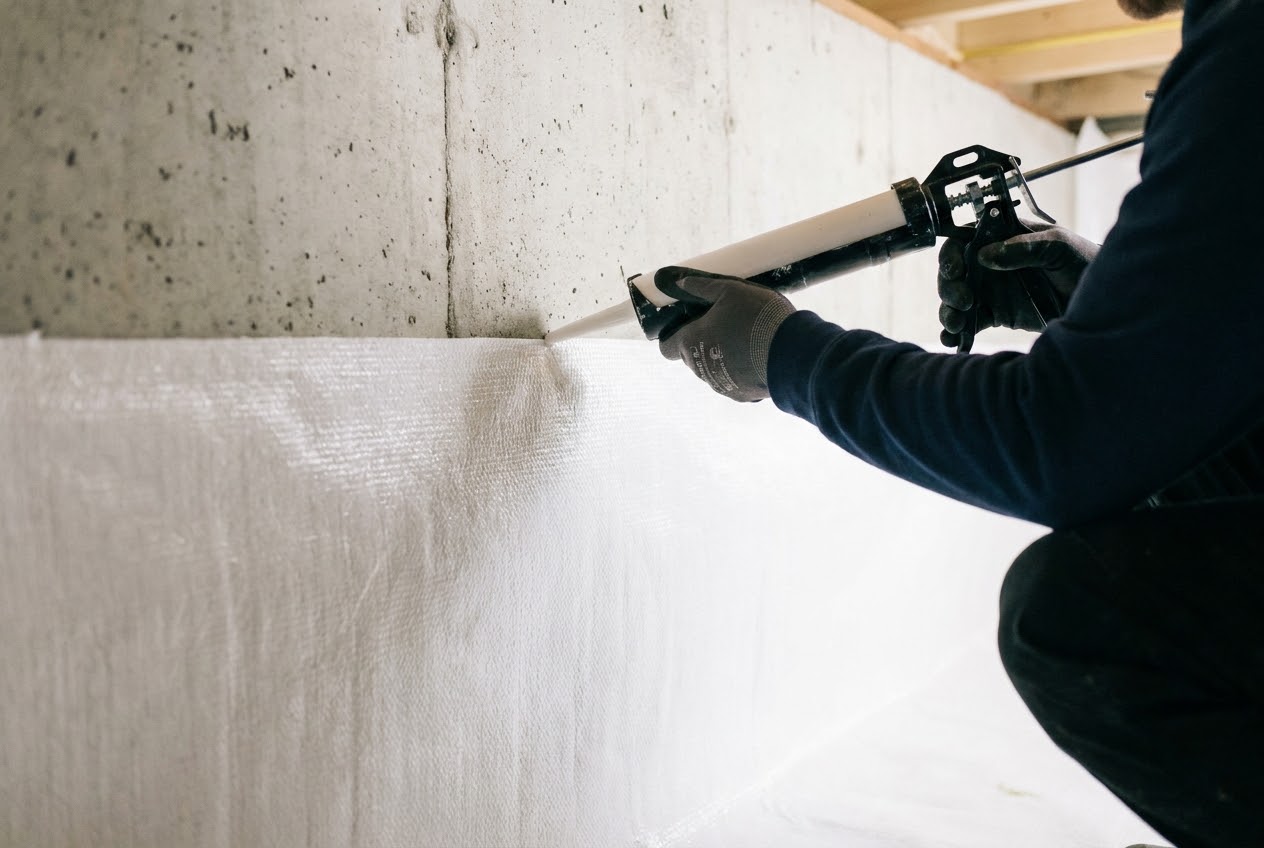
We don’t install vapor barriers. We install a system. The Nu-Crawl encapsulation method starts with a custom-fabricated liner — pre-measured to the exact dimensions of your crawlspace, 40 to 60 mils thick (several times heavier than standard plastic sheeting), and spray-seamed on-site into one continuous, unbroken surface.
The complete system includes:
Custom-fabricated seamless liner — spray-seamed on-site into one continuous surface
Reflective insulation on foundation walls — sealed to the liner without tape
Closed-cell spray foam in the sill boxes — seals the gap where foundation meets framing
All penetrations permanently sealed — sewer pipes, footings, columns, everything
Optional foam board underlayment for added insulation value
HVAC integration — your existing system conditions the crawlspace like a basement
Nu-Crawl vs. What You’ve Probably Been Quoted:
Nu-Crawl
Plastic & Tape
Concrete
True seamless installation
Puncture-resistant
Bonds to pipes & columns
No ongoing maintenance
Life expectancy
100 Years
Unknown
Unknown
What Changes After Crawlspace Encapsulation?
Your Air Quality Improves
Research consistently shows that a significant portion of the air circulating through your living space comes up from the crawlspace — the stack effect. Seal it, and you stop sending moisture, mold spores, and rockwool fibers upward into your home.
Your Floors Stop Being Cold
A conditioned crawlspace keeps the temperature under your subfloor consistent with the rest of the house. Many homeowners notice the difference in their first winter.
Your Energy Bills Come Down
Cut off the crawlspace as a path for outside air infiltration and your heating and cooling system runs less to hold temperature.
Your Radon Exposure Drops
Radon is a soil gas. The seamless Nu-Crawl liner acts as a passive radon barrier — and we can install a draw point for an active mitigation system if needed.
Flooding Doesn't Ruin Your Investment
Unlike plastic sheeting that lifts and separates when water comes in, the Nu-Crawl system is completely unaffected by flooding. After a heavy Illinois rain, your encapsulation is exactly as it was the day we installed it.

We Know Elk Grove Village Homes
Elk Grove Village has one of the strongest community identities in the Northwest suburbs — from the 17-acre elk pen off Higgins Road (the community’s actual namesake herd, brought from Yellowstone in 1925) to the Schuette-Bierman Farmhouse that’s stood since the 1850s. The homes here have history too. Many were built by the same developer, the same way, around the same time — and the crawlspaces under them were no different.
We’ve seen what happens to those original terracotta sump pit systems when they’ve been overwhelmed by modern rainfall. We know what 60-year-old rockwool looks like when it’s dropping off the wall and loose fibers. And we know exactly how to fix it — permanently.
Questions We Hear From Elk Grove Village Homeowners
How is this different from a regular vapor barrier?
A vapor barrier is plastic sheeting cut to fit, taped at the seams, and pinned to the walls. Nu-Crawl is a custom-fabricated liner spray-seamed into one continuous surface — no seams, no tape, no adhesive. It’s significantly thicker and bonds directly to structural surfaces.
What happens to my existing rockwool insulation?
We remove it as part of the installation. That material should come out anyway — it’s a health risk and it’s no longer performing effectively. The Nu-Crawl system replaces it with a properly sealed, insulated crawlspace that actually works..
How long does installation take?
Most installs are completed in one to two days. The liner is ready immediately — no curing time, no waiting, unlike concrete.
Do I have to maintain it after installation?
No. It’s bonded in place. Nothing to check, retape, or re-seal. No other crawlspace system we’re aware of carries a 100-year life expectancy.
Will this help with my energy bills?
In most cases, yes. When you cut off outside air infiltration through the crawlspace, your HVAC system runs less. It’s one of the most consistent benefits homeowners report after installation.
Ready to Stop Guessing What’s Going On Down There?
A cheap quote and a roll of plastic might look like a solution. But if you’ve got one of the original Centex-era crawlspaces under your Elk Grove Village home, that approach is going to cost you more in the long run — in energy, in comfort, and eventually in repairs. We offer free estimates with a straight answer from people who’ve been doing this for a long time. No pressure, no obligation.
(630) 360-2206 | crawlspaces.com
Serving Elk Grove Village and the surrounding Northwest Suburbs of Chicago